Transcript of an invited talk given at the DCMS Areas of Research Interest Event, UCL East, November 12th, 2026.
I have 10 minutes to make humanity count. It’s a tall order. But I honestly believe it’s worth trying. So here goes. Let me begin with an easy question – what are the Areas of Research Interest for? I ask this question not because I’m implying we don’t know, or that in some way we need to undo the excellent work the DCMS does in this area, but because I want to draw attention to the particular sense in which the Areas of Research Interest contextualise the department’s decision-making. And it is this question of how we contextualise cultural governance in the time of AI that I’d like to focus on in this talk.
So – what is my context? What am I bringing to the table this afternoon? Well…I’m going to very briefly say something about research I’ve been doing; research I’m doing now; offer a provocation; and end with a suggestion.
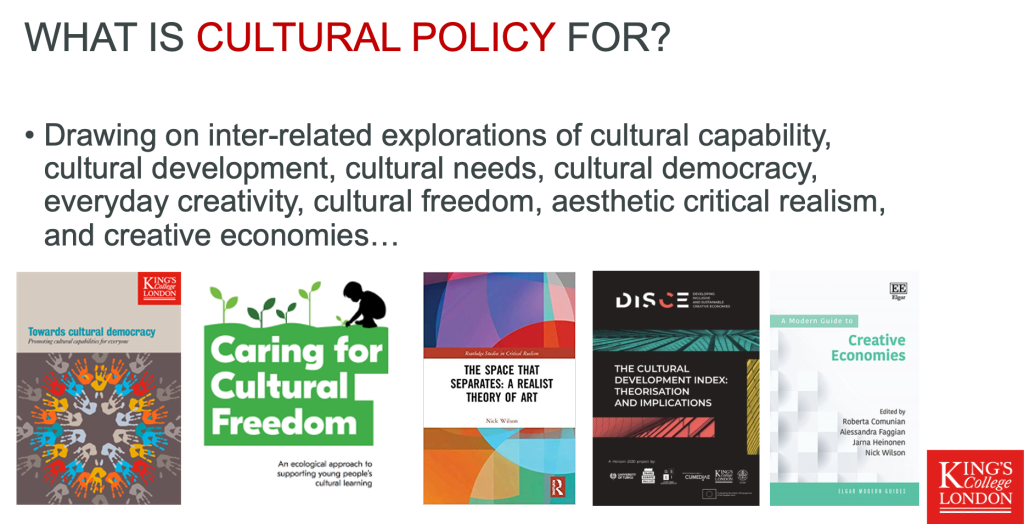
What research have I been doing? As hard as it is reduce over 25 years of research into one pithy statement – my work has sought to provide answers to this question: What is cultural policy for? I’ve done so drawing on inter-related explorations of cultural capability, cultural development, cultural needs, cultural democracy, everyday creativity, cultural freedom, art and aesthetic critical realism, and creative economies.
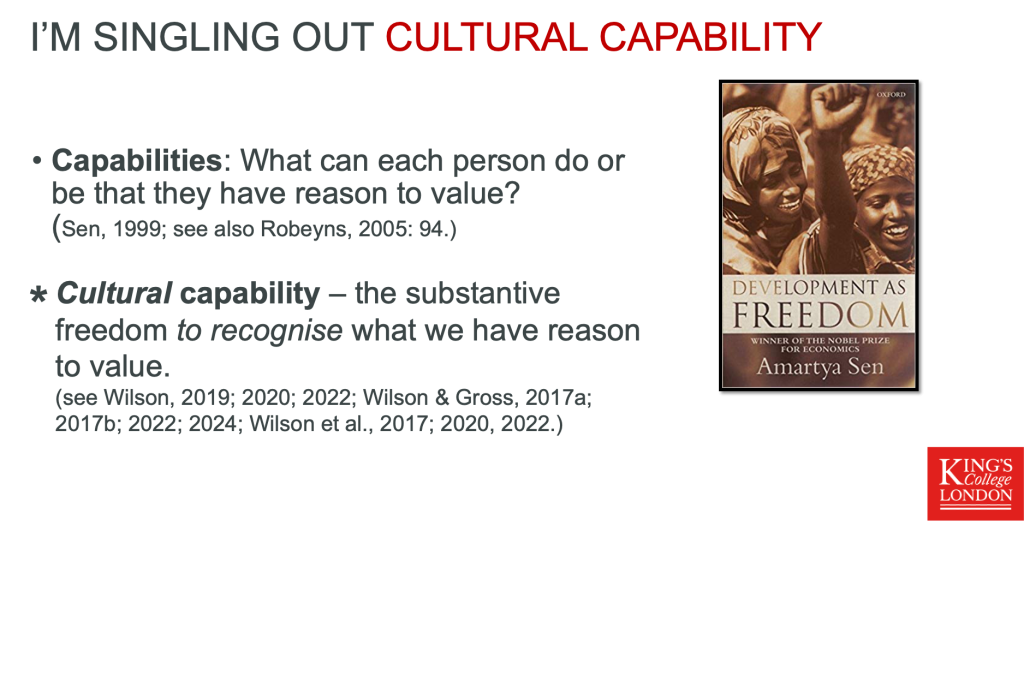
Today – I’m particularly singling out cultural capability. This is a strand of my research that builds centrally on Amartya Sen’s ground-breaking work on human development and capability – notably his critique of traditional welfare economics and the prioritisation of real freedoms over resources or utility. Sen argues that we should be focusing on expanding people’s capabilities – their real opportunities to do or be what they have reason to value.
My intervention – to the extent I can claim it as such – is to draw attention to the attendant idea that we cannot ‘do or be what we have reason to value’ without in some way, knowing or coming to know – in other words – recognising – what we have reason to value. And crucially, I suggest that this recognising what we have reason to value is not automatic or hydraulic. It is contingent; it is dispositional, it is also shared and relational…and this, implicitly, is very much at the heart of what the DCMS takes responsibility for and works to deliver across its portfolio. Returning to my over-arching research question – I suggest that enabling and promoting people’s cultural capabilities is then a central (if not the central) objective of cultural policy. And this is what I call cultural development.
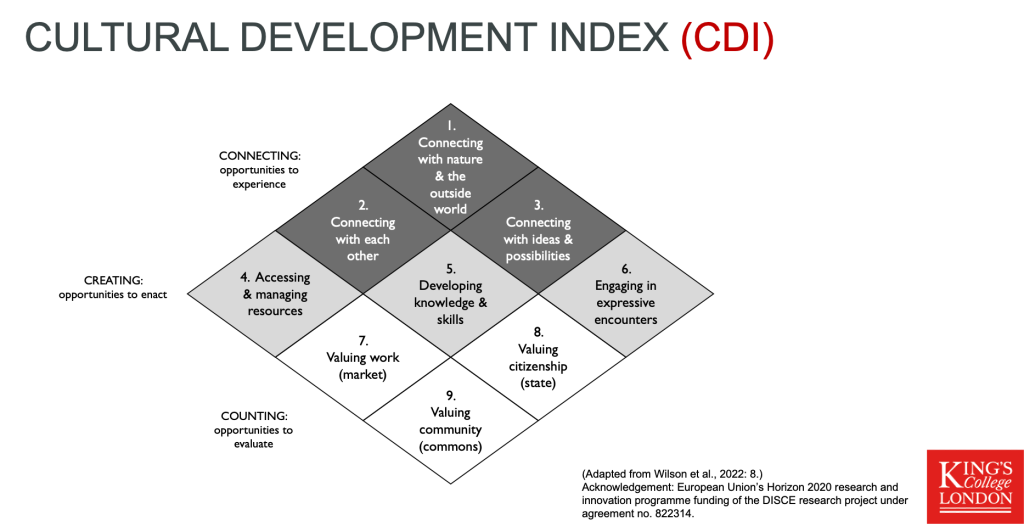
In Horizon 2020 funded research – Developing Inclusive and Sustainable Creative Economies (DISCE), and building on the UNDP’s Human Development Index and other indexes – together with colleagues, I put forward a Cultural Development Index – which casts further light on the kind of contexts that are important for developing cultural capability – across the 3 dimensions of CONNECTING, CREATING AND COUNTING these include opportunities or freedoms to experience; to enact, and to to evaluate. Whilst we developed quantitative measures based on a Local Opportunities Survey delivered in Medway, Dundee and Enschede in the Netherlands, the ‘index’ is perhaps most important in the sense of being ‘indexical’ – pointing to vital questions or areas – or ‘contexts’ of research interest – to be explored further.
This brings me to the research I’m doing now. Of course – the whole topic of what we recognise to be of value was called into question in the context of the pandemic. In January 2021 I launched a research project – ‘Cultures of Care’ – that gave me a space to explore further questions about the cultures (systems of value recognition) that we reproduce and transform everyday that enable us to care and be cared for. More recently I’ve been exploring deeper connections with my research on cultural development. In particular – I have wanted to move beyond the overtly-rational viewpoint that what we value is somehow something we ‘reason’ or ‘know’ in a cognitive sense.
And this has brought me to my most recent and still ongoing project – which is exploring our knowing ‘We Don’t Know!’. For the last 5 years or so I’ve been working on a book-length project that takes us beyond the idea that not-knowing is just the absence or lack of knowledge. We live on the edge of not-knowing (and so – knowing). Not-knowing is the context of our knowledge. Everything that we care about and for, that we hold most dear, unfolds in the place between knowing and not-knowing.
Consider, for example, in the arts – our paintings, sculptures, dances, music and songs, plays, novels, poetry, films; in our sports – our triumphs and losses; our sense of community and belonging; in our creativity – our imagination, intuition, possibility, hunch, gut-feel, intimation, mystery, revelation; and in our everyday lives – our celebrations, births, marriages, our sufferings, bereavements, deaths – none of these can be ‘understood’ as such – they are between knowing and not-knowing. This relation between knowing and not-knowing is what being is (for us).
So how does this relate to ‘humanity’? In referring to ‘humanity’ I don’t just mean humankind (the collective noun for human beings); I don’t just mean the virtues of humanity (compassion, kindness etc.); I don’t even mean that sense in which we are AI’s ‘other’ – human beings rather than machines. Humanity – as I define it – is what it’s like to be; it’s the humanness of being human. And this is the context of our knowing anything.
But here’s the thing: it is not an automatically present context; it is only present when and if we acknowledge it…requiring we ‘admit’ our being; we ‘allow’ our being to be what it is without changing it; and we ‘act in the light of’ our being. As such, I suggest that this disposition – humanity – is not something AI can simulate. And crucially – it is only in being that we come to experience worth (genuine value) – and so too, truth (genuine meaning); beauty (genuine connection).
Putting my research strands together, I’d like to offer a provocation:
I suggest that despite living at a time when we have more access to knowledge and rely more heavily on this knowledge than at any time in our history, we are beset by multiple crises – crises of inhumanity (i.e. where we fall out of being).
We are increasingly living in a de-contextualised ‘culture of knowledge’ rather than contextualised ‘cultures of care’. One of the primary symptoms of this de-contextualization is that we tend to value what we recognise rather than recognise what we genuinely value.
Here I might have in my sights the ways in which we interact with and through the market, the media, the internet – social media, likes and dislikes, the role of influencers, celebrity culture, superstar economics and so on. But also – in the context of this event today (particularly as we consider the visitor economy, place-focused growth, health and wellbeing); I’m bound to query both what we recognise (perhaps as ‘robust evidence’, in line with the Green Book, ROAMEF and such like), and what we fail to recognise, and so fail to address in our research and policy-making. As policy-makers and researchers, we must ask ourselves, reflexively – what is our cultural capability? After all, policy-making is a vital part of culture not sitting outside of it. Are we always contextualising our decision-making in our humanity?
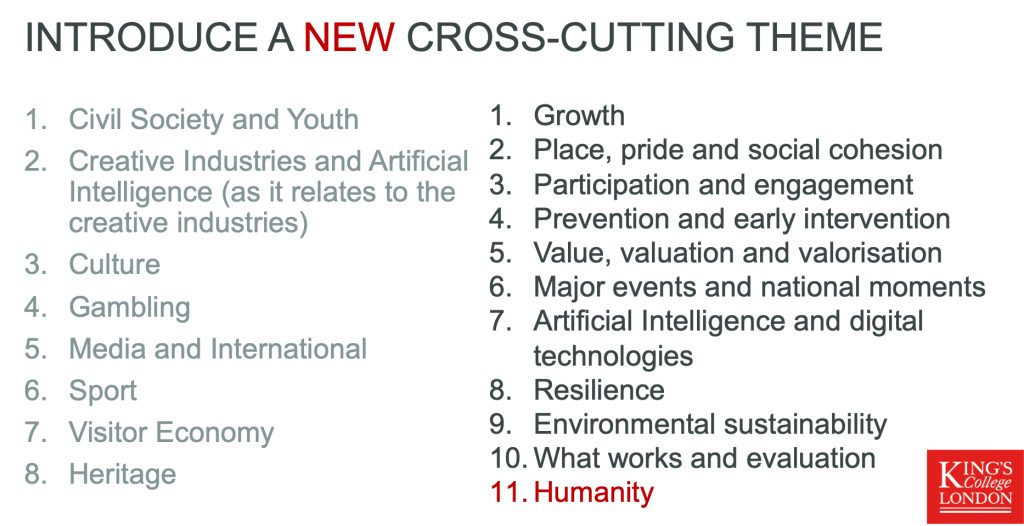
So to conclude – I’d like to make a suggestion. Reading through the list of Areas of Research Interest and then the Cross-cutting Themes – as listed here – it strikes me that there’s scope for introducing an additional cross-cutting theme: Humanity.
Why is this necessary? If you’re thinking – isn’t humanity implicit across all these areas and our decision-making …I might reply – yes – of course you’re right – at one level. But here I’d like to refer back to my Cultures of Care research and a statement by the political scientist Joan Tronto who is perhaps best known for pioneering the integration of care ethics into political theory and democratic practice. She writes: ‘no caring institution in a democratic society…can function well without an explicit locus for the needs-interpretation struggle, that is, without a “rhetorical space”…or a “moral space”…or a political space within which this essential part of caring can occur.’ It’s striking to me that this echoes a statement made in UNESCO’s 1995 publication Our Creative Diversity: Report of the World Commission on Culture and Development:
‘Cultural freedom leaves us free to meet one of the most basic needs, the need to define our own basic needs.’ We cannot take humanity for granted.
So – to conclude – Humanity (as a cross-cutting theme) is indexical – it points towards the contexts and questions to explore, and offers a vital feedback mechanism in the time of AI – a way of ensuring we align ourselves with reality. Humanity (as a cross-cutting theme) explicitly holds a space open for contemplating what we genuinely value, (re-)contextualising the decisions the DCMS and its partner organisations make in relation to our being not just our knowing.
So let’s make humanity count. Thank you.